
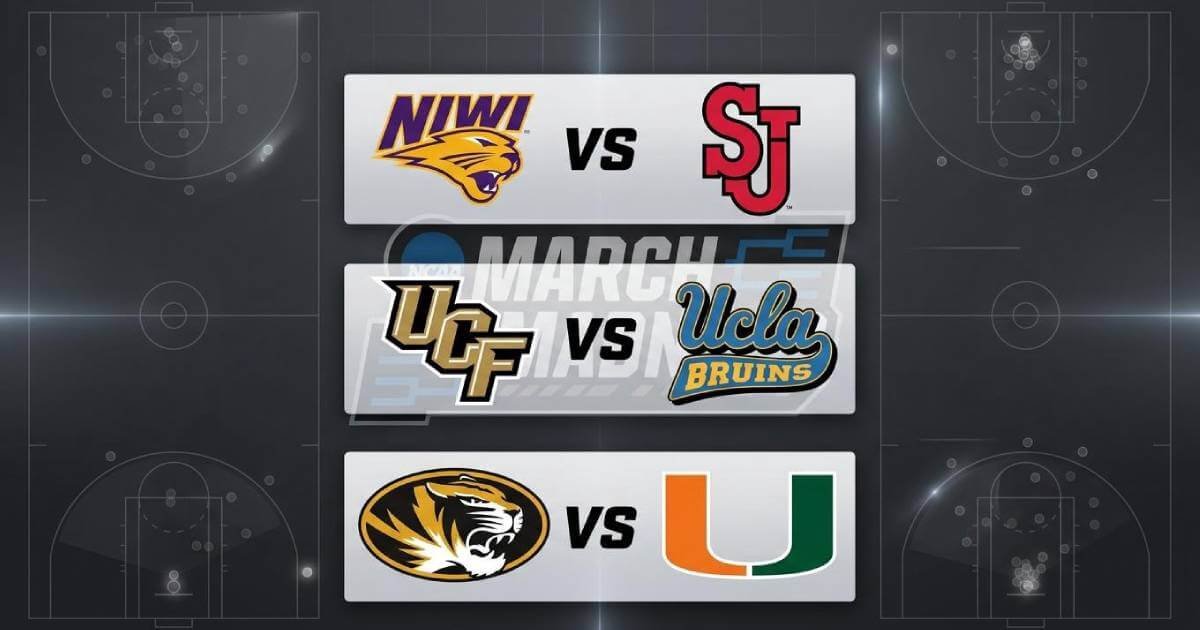
Friday evening delivers three distinct tournament archetypes: the 5-12 upset script, the power-conference clash with pace tension, and the coin-flip seed mismatch where home geography warps the line. The market has already rendered its verdict on each, but the institutional flow tells a more nuanced story than the bracket reveals. From San Diego to Philadelphia to St. Louis, these are the matchups where efficiency metrics and market structure diverge most sharply.
Northern Iowa Panthers vs. St. John’s Red Storm
Market Breakdown & Analysis:
The spread has settled at St. John’s -10.5 after opening near -9.5 in early lines, but the structural case for Northern Iowa is among the strongest in the entire first round. Model projections call for a 72-68 St. John’s victory, creating roughly 5.1 points of value on the Panthers’ spread. This disconnect stems from classic seed anchoring: the market sees a 5-seed Big East champion against a 12-seed Missouri Valley automatic qualifier and extrapolates blowout risk. The efficiency metrics tell a different story.
Northern Iowa arrives with the 21st-ranked adjusted defense nationally and elite ball security (361st in pace, fewest possessions surrendered in the field). The Panthers’ ability to compress games into the 60s directly undermines St. John’s preferred transition attack. The Red Storm generated 480 fast-break points this season against Northern Iowa’s 232, but pace control is not neutral-site portable. Trey Campbell’s tournament run (17.8 PPG on 48.3% from three through four MVC elimination games) provides credible shot-making variance against a St. John’s defense that thrives on forcing turnovers (19.4% defensive turnover rate) against loose ball-handling.
The rebounding margin is the Red Storm’s legitimate structural edge: a 12.4 percentage-point advantage on the glass creates second-chance opportunities that could prove decisive in a low-possession environment. Zuby Ejiofor’s Big East Player of the Year campaign (16.3 PPG, 7.1 RPG) anchors interior scoring that Northern Iowa’s pack-line principles will struggle to erase without fouling. However, the total at 132.5 assumes St. John’s can impose its pace. If the Panthers execute their tempo mandate, Under 132.5 becomes the correlated position with their spread cover.
Market structure reveals institutional interest in the dog: despite St. John’s commanding public support as a brand-name favorite, the line has not pushed through -11. The lack of steam on a heavily bet side suggests books have absorbed respected positions on Northern Iowa. This is the “Frozen Line” signal in CBB markets: when >75% of market participation gravitates toward a favorite without line inflation, the consensus price already embeds downside risk.
Value Pick: Northern Iowa +10.5 (-112). The defensive profile, pace control, and 5.1-point model edge against seed-inflated pricing create the clearest structural position on the Friday slate.
UCF Knights vs. UCLA Bruins
Market Breakdown & Analysis:
The UCLA -5.5 line has held steady since opening, with the total settling at 152.5 after initial looks near 152. This is a classic pace-compression case study: UCF’s 82.2 PPG scoring average and UCLA’s 78.0 PPG suggest fireworks, but the underlying possession structures clash sharply. The Bruins’ 70.9 points allowed per game (against Big Ten competition) and UCF’s 78.8 defensive rating in the Big 12 create defensive floor assumptions that the market may be undervaluing.
Tyler Bilodeau’s 18.0 PPG and 51.8% shooting provide UCLA with efficient half-court creation, while Donovan Dent’s 7.5 assists per game against 1.9 turnovers represent elite ball security. Conversely, UCF’s Jamichael Stillwell anchors a glass-attack strategy (3.2 offensive rebounds per game individually, 10.6 team OREB rate in the Big 12) that generates extra possessions without requiring made baskets. Riley Kugel’s 14.7 PPG provides perimeter variance, but his 42.1% field goal percentage suggests efficiency risk against Mick Cronin’s defensive schemes.
The total at 152.5 assumes both teams execute their offensive identities. However, tournament pressure historically compresses possessions for teams outside the top 25 in adjusted tempo. UCLA’s Big Ten Tournament run (78.3 PPG) came against familiar opponents with established scouting reports; UCF has not faced a defense of this caliber since February’s collapse against Arizona (81-59 loss). The Knights’ 3-7 record in their final 10 games entering the tournament – including a 104-111 shootout loss to Oklahoma State – reveals defensive structural issues that fast-paced games exploit.
Market structure shows no meaningful RLM or steam signals, suggesting efficient pricing. The -227 moneyline on UCLA implies 69% win probability, which aligns with KenPom-style projections given the strength-of-schedule performance differential in conference, where UCLA has the edge. The absence of line movement toward UCF despite their tournament Cinderella narrative suggests institutional skepticism about their defensive viability.
Value Pick: Under 152.5 (-112). The pace-compression mechanics of tournament play, combined with UCLA’s defensive discipline and UCF’s late-season defensive regression, create total downside that the market’s offensive priors ignore.
Missouri Tigers vs. Miami Hurricanes
Market Breakdown & Analysis:
The Miami -1.5 line represents substantial movement from KenPom’s initial 3-point projection, with the total compressed from 150.5 to 145.5. This adjustment reflects both market pricing of Missouri’s “home” advantage in St. Louis and sober reassessment of Miami’s late-season defensive profile. The Hurricanes closed with losses in 3 of their final 4 games, including an 84-62 dismantling by Virginia that exposed backcourt vulnerabilities.
Missouri’s 79.7 PPG against Miami’s 81.9 PPG suggests offensive parity, but the underlying Four Factor margins diverge. Miami’s 50% field goal percentage and 37.3 rebounds per game indicate efficient shot-making and glass control, while Missouri’s 49% shooting and 35.6 rebounds suggest similar offensive quality with defensive rebounding risk. The turnover battle is decisive: Miami’s 7.9 steals per game against Missouri’s 6.7 creates transition opportunity asymmetry that the Hurricanes have exploited against ACC competition.
The situational spot is analytically complex. Missouri’s 2-3 record in its final five games includes an overtime loss to Arkansas and double-digit defeats to Kentucky and Oklahoma, suggesting late-season regression. However, the Tigers’ 10-8 record in the SEC (tied for 7th in a 16-team conference with 11 NCAA Tournament bids) represents substantially tougher competition than Miami’s 13-5 ACC mark in a down year for the conference. The market appears anchored to Miami’s 25-8 overall record while underweighting schedule strength differential.
Line movement toward Missouri (-1.5 opening toward pick’em in some markets despite public Miami support) indicates respected money on the Tigers. The correlation between spread and moneyline is instructive: Missouri at -101 implies 50.2% win probability, nearly identical to their spread-implied cover probability. This flat structure suggests the market views this as a genuine coin-flip where possession variance matters more than talent differentiation. In such environments, the points carry structural value.
Tournament-specific psychology favors the late Friday night window: Miami’s veteran core (including transfer portal acquisitions) has March experience, but Missouri’s desperation index is higher given their bubble-adjacent seeding and conference tournament flameout. Desperation metrics are notoriously difficult to price but historically favor underdogs in coin-flip spreads.
Value Pick: Missouri +1.5 (-118). The geographic pseudo-home advantage, schedule strength underpricing, and line movement toward the Tigers despite public Miami support create a classic CBB tournament value position.
Slate Summary: Consolidated Value Positions
This three-game cluster on Friday presents distinct market inefficiencies. Northern Iowa +10.5 offers the largest structural edge (5.1 points) against seed-anchored pricing, making it the highest-confidence position. UCLA-UCF Under 152.5 captures pace-compression mechanics that tournament pressure amplifies. Missouri +1.5 exploits schedule-strength underpricing in a coin-flip spread with correlated moneyline value.
The institutional flow patterns are consistent: respect for defensive profiles and pace control over brand-name recognition and seed differential. In March, the market’s retail bias toward favorites and overs creates systematic value on disciplined underdogs and compressed totals. These three positions align with that structural alpha.
Consolidated Value Slate: Northern Iowa +10.5 (-112), UCF vs. UCLA Under 152.5 (-112), Missouri +1.5 (-118).
Market data reflect consensus odds as of March 20, 2026, 5:46 PM EDT. Odds and prices are subject to change.