
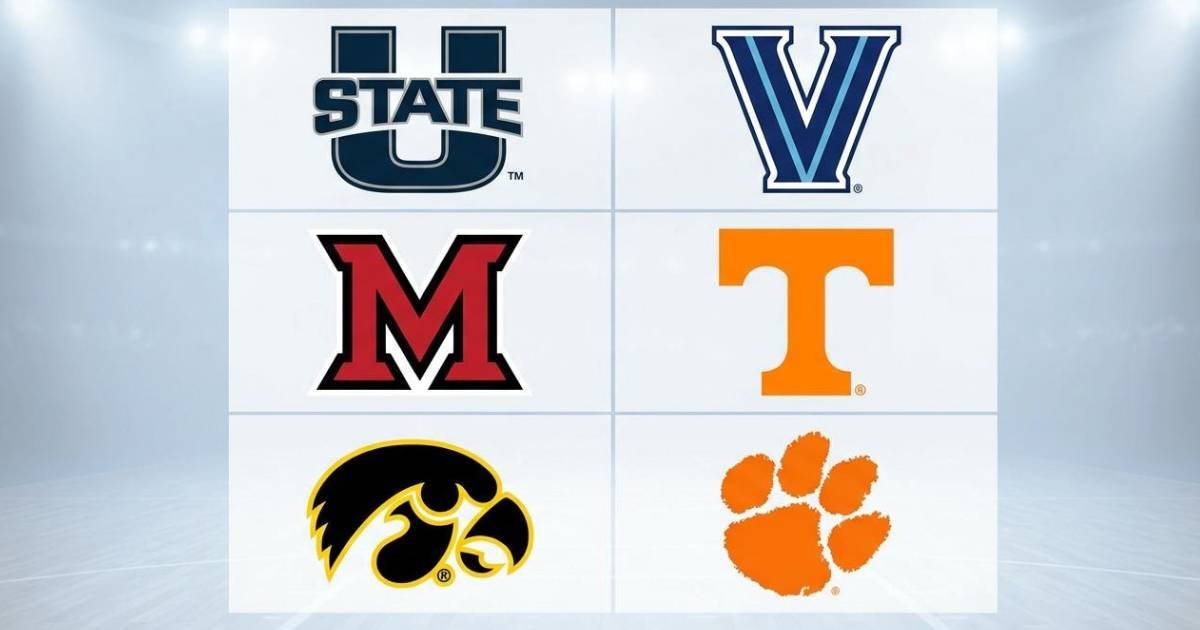
Friday afternoon delivers a tournament slate with three distinct market profiles: a conventionally tight 8-9 matchup showing respected buy-back, a double-digit chalk spot with pace compression risk, and a diminished favorite facing structural roster decay. Each presents unique pricing dynamics worth unpacking before tip.
Utah State Aggies @ Villanova Wildcats
Market Breakdown & Analysis:
The opening line of Utah State -2.5 has compressed to -1.5, a full point of reverse line movement despite the Aggies’ superior offensive efficiency metrics (50.1% FG vs. Villanova’s 45.9%). This contraction signals respected money hitting Villanova at the opener. The total has simultaneously drifted down from 147.5 to 146.5, suggesting institutional flow toward the under in what profiles as a moderate-tempo matchup.
Villanova arrives with defensive rebounding strength: Dionte Brennan’s 10.5 boards per game and 6.4 defensive rebounds create possession extension opportunities that could frustrate Utah State’s transition rhythm. The Aggies’ 83.0 PPG scoring rate was built largely in the Mountain West; the step up in competition density at the Big East level represents an unpriced adjustment.
The spread-to-total ratio here is tight: a 1.5-point spread in a 146.5 total implies minimal scoring separation. Utah State’s 8.7 steals per game against Villanova’s 9.3 turnovers per game creates a turnover battle that could flip possession economics. However, the RLM toward Villanova suggests the market has already priced in Utah State’s statistical advantages as inflated by conference quality.
Villanova’s recent form shows vulnerability: the 89-57 demolition at St. John’s and 78-64 loss to Georgetown in the Big East Tournament represent back-to-back failures against high-major competition. This creates a behavioral bias opportunity: the market may be overcorrecting toward Villanova based on early money while ignoring recency regression.
Value Pick: Utah State Aggies -1.5 (-110). The RLM creates price improvement on the superior offensive team. The Aggies’ 50.1% shooting and 17.7 assists per game against Villanova’s 2.2 blocks per game suggest rim pressure that the Wildcats cannot schematically answer. The opener buy-back on Villanova has created a -1.5 entry point on a team that should be -3 or higher.
Miami (OH) RedHawks @ Tennessee Volunteers
Market Breakdown & Analysis:
The line has expanded from Tennessee -10.5 to -12.5, with multiple sources showing variance at -11.5. This movement with the public creates a classic large-spread calibration scenario. The 12.5-point spread against a 148.5 total generates a possession premium concern: Tennessee must build a margin at a rate that requires sustained offensive efficiency in a game where Miami (OH)’s 90.6 PPG scoring rate suggests pace resistance.
Miami (OH)’s 32-1 record does not represent the classic “hopeless dog” trap structurally, yet the 12.5-point cushion enters the historically profitable territory for CBB underdogs. The RedHawks’ 21.2 PPG scoring margin over Tennessee’s defensive allowance (90.6 vs. 69.4) is a meaningless cross-sample comparison (MAC vs. SEC), but the underlying offensive competence is real: 49.1% shooting across their last ten games.
Tennessee’s 6-4 record across their last ten games, with a 44.4% shooting clip, shows offensive volatility that the market is ignoring. Ja’Kobi Gillespie’s 18.0 PPG and 5.5 APG are impressive, but the Volunteers’ 74.2 points per game during this stretch falls well below the pace needed to cover double-digit spreads consistently.
The total at 148.5 sits in an awkward zone: Miami (OH) wants to play fast (90.6 PPG), but Tennessee’s defensive identity (69.4 points allowed) creates pace suppression pressure. The market has priced this as a moderate-over game, but the structural dynamic favors under if Tennessee controls tempo. The RedHawks’ 110-108 overtime win against Ohio on March 6 shows they can survive in track meets; their 89-79 play-in victory over SMU demonstrates tournament-specific resilience.
The behavioral bias here is “record anchoring”: Miami (OH)’s 32-1 record against weak competition creates reflexive dismissal, yet their single loss (UMass in the MAC Tournament) came against a team with comparable athletic profiles to Tennessee’s mid-tier SEC opponents.
Value Pick: Miami (OH) RedHawks +12.5 (-112). The spread expansion creates cover probability at a structural threshold. Tennessee’s offensive inconsistency and Miami (OH)’s pace-forcing capability suggest the Volunteers will win but fail to separate. The -680 moneyline implies an 83.3% win probability that feels inflated given Tennessee’s recent form and the RedHawks’ tournament momentum.
Iowa Hawkeyes @ Clemson Tigers
Market Breakdown & Analysis:
The line has compressed from Iowa -2.5 to -1.5, a mirror of the Utah State/Villanova dynamic but with a clearer structural explanation: Clemson is without Carter Welling, their second-leading scorer and top rebounder, who suffered an ACL injury in the ACC Tournament. The market’s reluctance to push Iowa beyond -1.5 despite this absence suggests institutional skepticism about Iowa’s own quality.
The current total market at 130.5 shows stabilization at a low number. This is the lowest total on the slate by 16 points, reflecting Clemson’s defensive profile (66.3 points allowed) and Iowa’s recent offensive struggles: the Hawkeyes have lost four of their last five, including 72-69 to Ohio State, 84-75 to Nebraska, and 71-68 to Michigan.
Bennett Stirtz’s 20.2 PPG and 4.4 APG represent Iowa’s entire offensive architecture. The market is pricing this as a star-vs-star matchup against RJ Godfrey’s 11.7 PPG, but Welling’s absence removes Clemson’s interior defensive anchor. This creates a schematic mismatch: Stirtz’s 49.8% shooting and 84.4% free-throw rate suggest downhill pressure that a Godfrey-led frontcourt cannot contain without Welling’s help defense.
Clemson’s recent form showed resilience pre-injury: 80-79 over North Carolina, 71-62 over Wake Forest, 79-76 over Georgia Tech. The 73-61 loss to Duke in the ACC Tournament was competitive until late. The Welling injury represents an unquantified adjustment: the market has moved only one point, but roster continuity in tournament settings typically warrants 2-3 point adjustments for absent starters.
The under’s pricing at 130.5 reflects recency bias on Iowa’s offensive failures without accounting for Clemson’s defensive degradation. The Hawkeyes’ 49.0% shooting against Clemson’s 45.8% suggests an offensive efficiency advantage that the total does not capture. The spread compression creates a “buy-back” opportunity: Clemson money has improved the Iowa entry price.
Value Pick: Iowa Hawkeyes -1.5 (-109). The Welling absence is underpriced by the market. Iowa’s offensive structure through Stirtz exploits Clemson’s diminished interior defense, and the Hawkeyes’ recent losses came against superior competition (three Quad 1 opponents) that prepared them for tournament intensity. The -1.5 spread with -126 moneyline correlation offers superior value to the flat moneyline.
Slate Summary & Structural Positioning
Friday afternoon presents three distinct market inefficiencies: RLM-created value on Utah State, spread inflation on Tennessee, and injury underreaction on Iowa. The common thread is market overcorrection to narrative (Villanova’s brand, Tennessee’s SEC pedigree, Clemson’s recent competitive form) at the expense of structural fundamentals.
The Utah State and Iowa positions both exploit compressed lines that have moved toward underdogs despite superior favorite fundamentals. The Tennessee position is contrarian by necessity: taking Miami (OH) requires accepting MAC quality against SEC athleticism, but the 12.5-point cushion creates mathematical cover probability that the Volunteers’ offensive volatility cannot justify closing.
Consolidated Value Plays:
1. Utah State Aggies -1.5 (-110)
2. Miami (OH) RedHawks +12.5 (-112)
3. Iowa Hawkeyes -1.5 (-109)
Market data reflect consensus odds as of March 20, 2026, 2:57 PM EDT. Odds and prices are subject to change.